When History Fell from the Sky

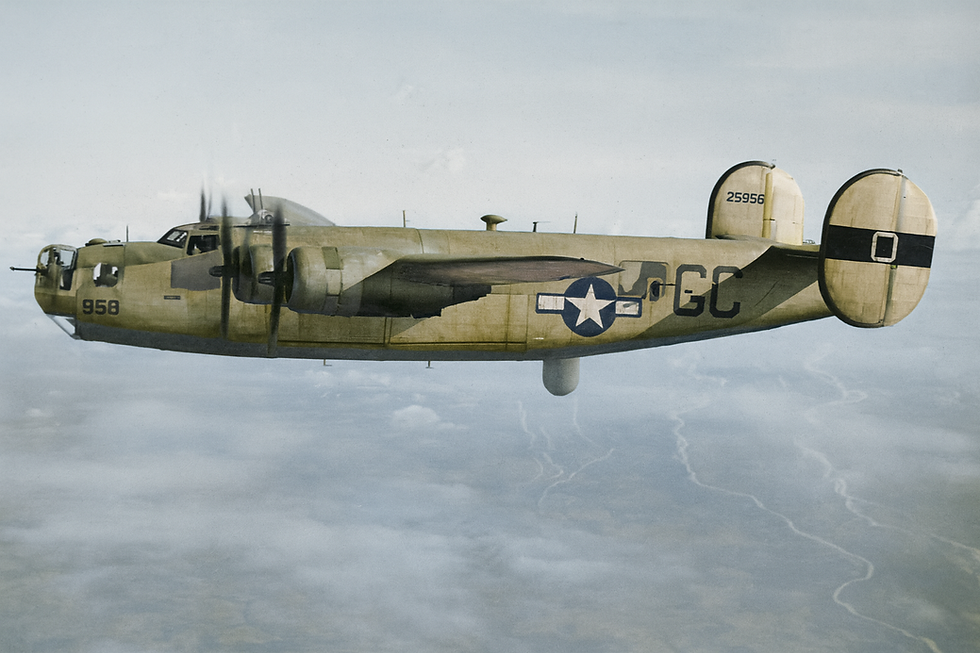
B-24 #42-51958 of the 579th Squadron, piloted by 1st Lt. Roy L. Miller, departs the target area over Magdeburg, Germany, following the mission of March 3, 1945.
They’d been here before. The men of the Hummel crew, flying their worn B-24 with the 579th Squadron, had struck Magdeburg the day before. But when dawn broke over Wendling on March 3, 1945, orders came to finish the job. The synthetic oil plant northeast of the city—one of Germany’s last lifelines—had to be erased from the map.
At 6:20 a.m., twenty Liberators began rolling down the runway, each carrying ten 500-pound general-purpose bombs. The target briefing was grimly clear: “Enemy capabilities in the target area will permit up to 300 enemy fighters in the air… Harassing attacks by Me-262s can be expected.” The Luftwaffe’s new jet-propelled fighters had become a terrifying rumor whispered in briefing rooms. Today, those rumors would become real.
At altitude, the cold bit through everything—skin, metal, nerves. Contrails laced the sky as the formation turned toward Magdeburg. Below, Germany’s heartland stretched in patches of gray and white, and ahead, black flak bloomed like flowers. The 577th Squadron led the attack, their bombs scattering across the target and down toward the docks. Explosions rippled through the oil tanks, fires spreading across the refinery complex. The 576th Squadron, flying high, dropped early—too early—and their bombs landed harmlessly in open fields. War rarely played out perfectly. Still, the damage below was severe. The target was burning.
Then came the sound—something different, almost alien. A jet. From the nose turret of one B-24, Staff Sergeant John P. Malley spotted it first. A silver streak slicing through the contrails. “Me-262!” someone shouted over the interphone. The fighter had already torn through two bombers, diving fast on the formation. Malley swung his guns and opened fire at nearly 2,000 yards, tracing his rounds into the oncoming blur. “My tracers went into one of his jets,” he later recalled. “Smoke and flames shot out, and he broke away. Our navigator saw him break up and go down. It was over in seconds. But in that brief exchange, history was made. S/Sgt. John Malley had just become the first gunner in the 2nd Air Division—and the 392nd Bomb Group—to shoot down a German jet fighter.
Elsewhere in the formation, tail gunner Joseph Berry of Lt. John Daley’s crew watched the chaos unfold. “Flak heavy, accurate,” he wrote later. “Bandits seen. Jet Me-262s. P-51 shot down, B-24s collided. Almost had collision in our own formation.” In the haze of smoke and contrails, the air was a maze of death. Only later did Berry learn that the jet heading for his own ship had been the same one Malley destroyed—a kill that likely saved their lives.
By the time the Hummel crew turned for home, the skies behind them burned. The oil plant was in flames, smoke columns rising thousands of feet high. Ten bombers returned to Wendling riddled with holes, hydraulic lines cut, engines coughing black oil. But they made it home. At 1:20 p.m., their wheels touched down on English soil. Another mission complete.
The war was nearing its end, but over Magdeburg that day, the future had already arrived—jets, speed, innovation. And yet, it was courage, faith, and the steady hand of a gunner that carried the day. The sky had changed forever, but so had the men who flew through it.


Comments